Showing posts with label book. Show all posts

Thursday, June 8, 2017

The Reports of Edward Coke - 1602


Sir Edward Coke was an English barrister, judge and, later, opposition politician, who is considered to be the greatest jurist of the Elizabethan and Jacobean eras.

A portrait of a brunette man in his 40s, with a brunette beard and mustache. He is wearing a shapeless black robe and a Jacobean ruff; to the right of his head is a coat of arms with a motto underneath it. On the bottom right of the portrait is a paragraph of indistinguishable text, while the entire picture is captioned "Given by the descendent Thomas William Coke 1780+".

Coke's Law Reports (a.k.a. Coke's Reports) were a collection of judgements from cases he had participated in, watched, or heard of. Contemporaries such as Theodore Plucknett, John Baker, and Francis Bacon praised the work's richness of detail, and foresaw the influence and importance of the reports. The reports were originally written into seven notebooks, four of which are lost.


This volume still has it's closure ties, though the cover does show extensive wear and tear. 

Full title in French:
Le second part des reportes del Edvvard Coke Lattorney Generall de Roigne de diuers matters en ley, auec grand & mature consideration resolue, & ... adiudge par deuant.

It appears the rest of the text is in Latin.


Though the cover shows some aging, as do the corners of pages, the text is still intact. This is pretty great considering this item is around 415 years old!


Wednesday, May 17, 2017

The Tryal of Thomas 1st Earl of Macclesfield

We just got in a lovely 1725 copy of the proceedings in the trial of Thomas Earl of Macclesfield. Not having much knowledge about this trial, I decided to do some research.


Thomas Parker was the son of an attorney (of the same name), who stayed in the family business. In 1691 he was called to the bar, and became a Member of Parliament. He served under the monarchs Queen Anne and King George I, and was was a favorite of the King; so much so, he was knighted in 1705 and made Privy Counsellor in 1710 after refusing the office of Lord Chancellor.

The Earl of Macclesfield, as depicted by Sir Godfrey Kneller.

Thomas was Lord Chief Justice, the second-highest judge of the Courts of England and Wales, from 1710 to 1718, during which time he was elevated in title to Baron Parker of Macclesfield. His movement up the ladder did not stop there. When Queen Anne died on August 1, 1714 her successor, George I, was in Germany, so Baron Parker was designated Regent until the new king could take the crown. Parker ended up governing until September 18, 1718, and even gave the King's Speech in the House of Lords since the new monarch could not speak English.
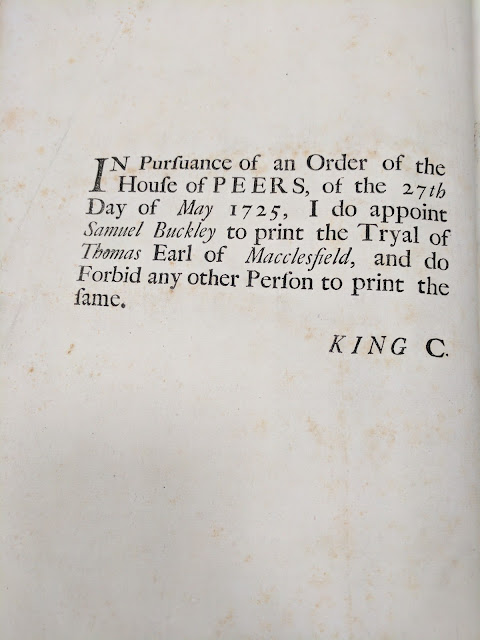


In 1718, he became Lord Chancellor, and was eventually advanced to the title of Earl of Macclesfield in 1721 with an additional title of Viscount Parker. However in 1725, fortune averted her gaze from Parker. In this year, Parker was impeached and tried in the House of Lords. The ruling was found unanimously to convict him of corruption. It turns out, Parker took more than £100,000 in bribes, which is somewhere in the range of  £11,000,000 today. He was jailed in the Tower of London and required to pay a £30,000 fine before being released. This conviction lead Parker to resign as Lord Chancellor, and to be struck off the roll of the Privy Council.


Unfortunately for Parker, his money was confiscated as part of court proceedings, and thus, this once wealthy man had no resources to quickly pay his fine. Once released from the Tower, Parker spent the rest of his life at his son's estate, Shirburn Castle. 

Tuesday, January 24, 2017

1852 Proceedings of the Annual Communication of the Grand [Masonic] Lodge of Alabama

Today is conspiracy theory gold! Had the 1852 Proceedings of the Annual Communication of the Grand [Masons] Lodge of Alabama come through my desk today. Snapped a few pics that include the Masonic calendar for that year. It's a gorgeous, yet delicate, book. However, some of the wording inside the book definitely gave me the heebie jeebies. THE TRUTH IS OUT THERE!


Tuesday, January 17, 2017

The Cutter

The Cutter in Five Lectures Upon the Art and Practice of Cutting Friends, Acquaintances, and Relations
- this particular copy is from 1808, and just arrived bubble-wrapped to the heavens! It really is gorgeous (and quite the funny read)! 


Tuesday, January 10, 2017

Witchcraft in Old and New England

Had this lovely book from 1929 come in this morning. I'm so excited to read through it!The accessible materials for a history of Elizabethan witchcraft are scattered and fragmentary. Much is lost. We cannot hope to understand the prosecutions of the last sixty years of the 17th century, whether in Old England or New, until we arrive at a substantially accurate comprehension of what was thought and done at the close of the great queen's reign. Contents; typical case; English witchcraft before 1558; image magic and the like; love and hate; madness, curses and the elfshot; Venefica; charms ghoulish and profane; wind and weather; witch in the dairy; metamorphosis; mirrors and thieves; treasure trove; haunted houses and haunted men; the seer; cold water; company and the witches; Sabbath; King James I; witchcraft and the Puritans.


Tuesday, January 3, 2017

Complaints and Disorders: The Sexual Politics of Sickness

This awesome 1973 pamphlet graced my desk -

Complaints and Disorders: The Sexual Politics of Sickness

Introduction paragraph:
"The medical system is strategic for women's liberation. It is the Guardian of reproductive technology-birth control, abortion, and the means for safe childbirth. It holds the promise of freedom from hundreds of unspoken fears and complaints that have handicapped women throughout history."

It has some pretty awesome photos and cartoons inside. (see photo)


Tuesday, December 27, 2016

Thomas Ashe's First Work - 1588

This Christmas miracle is a beautifully preserved first edition of Thomas Ashe's first work titled:

"La Table al lieur des Reports del tresreuerend Judge Sir Iames Dyer Dhiualer, iades chiefe Iustice del common banke: per quel facilment & troueront toutes choses conteinus in icel ore tarde compose per T[homas] A[she]"

Ashe was an English legal writer who entered as a student of he Honourable Society of Gray's Inn, one of the four professional associations for barristers and judges in London, in 1574. He was called to the bar on January 24, 1582-3 and finally became pensioner of his inn on October 17, 1597.

This work is the first abridgment of any reports of a named reporter, and launched Ashe's career as the master and pioneer of this genre of legal literature.


The work is bound in contemporary calf. 

Minimal cracking, and firm joints


Tuesday, December 20, 2016

American Bandits

A 1938 copy of "American Bandits" which is a really fun, short read! The deeds of Jesse James, Bonnie and Clyde, as well as other notorious American outlaws, rebels, and gangsters are highlighted in this book!


Tuesday, December 13, 2016

Dr. Welwood's Memoirs

A copy of Dr. Welwood's Memoirs printed in 1702. The cover has beautiful blind stamping, and inside there are signs of pesky bookworms (yes, they're real)!


Tuesday, December 6, 2016

A Philosophical Enquiry into the Origin of the Sublime and Beautiful

Today we got in a 5th edition of Edmund Burke's "A Philosophical Enquiry into the Origin of Our Ideas of the Sublime and Beautiful" from 1772. This was the first complete philosophical work contemplating the separation of the sublime and beautiful into their own respective categories. This was a very controversial work, and was commented on by Immanuel Kant and drew the attention of Denis Diderot.


Tuesday, November 29, 2016

Memoirs of Sir Robert Peel

A copy of the "Memoirs of Sir Robert Peel" from 1857. What a beauty! The gilded edges are not only decorative, but serve a purpose. They help protect the pages from browning, moisture, and dust.

A little about the subject: Sir Robert Peel twice served as Prime Minister of the U.K. (December 1834 - April 1835 & August 1841 - June 1846). He is thought of as the father of modern British policing and a founding member of the modern Conservative Party.


Tuesday, July 12, 2016

Classification of Resources I: Concepts, Problems, Issues

Two Perspectives on Classification
  • Classificationists (i.e. editor) - those who create and edit the conceptual places to put things
    • Need to create workable classifications
      • What is the basis for a classification?
      • What are the ramifications of a classification?
      • How hospitable is a classification to changes in knowledge over time?
  • Classifiers - those who place things into these created places when organizing
    • Need places to put things
      • Is there a place for this thing?
      • Is this think with other like things?
Classical Classification
  • Aristotle and the natural world:
    • Mutual exclusivity: "in or out" - something is an animal or it is not an animals
    • Inheritance: based on the assumption that there is a natural hierarchy to the world (all animals share same characteristics that differentiate them from plants)
    • Basis for scientific classification
  • Medieval scholastics and their resources:
    • Classification of scholarly materials based on the academic divisions of study of that time - 
    • This classification reflected those areas taught to scholars. 
    • Classification provides the basis for shelf arrangement.
Scientific (Linnaean) Classification


  • Largest example of formal classification:
    • Managed over time by classificationists
    • Binomial nomenclature (genus/species)
    • Specific rules for classifiers to follow (e.g., members of the same species are capable of interbreeding to produce fertile offspring)
  • Follows classical approach:
    • Mutual exclusivity of classes
    • Inheritance
  • EXAMPLES:
    • Two species contexts:
    • Dealing with changes in the classification itself:
      • Evolution of existing species - e.g. newly emerging drug resistant infectious diseases.
      • Newly discovered species - e.g., the division of Monera into two distinct kingdoms
Library Classification
  • Inspired by scientific classification:
    • Early library classificationists were leaders in the application of classification principles outside of the scientific domain
    • However, book classification provided challenges in comparison to the classification of natural objects
    • Is a book like a starfish?
  • Historically U.S. libraries used classification for shelf arrangement, while European libraries used classification to facilitate retrieval of surrogates:
    • Open stacks require a system for shelf arrangement of books
    • Closed stacks rely on the catalog to provide logical groupings
The Nature of Book Classification
  • Collocating objective: Bringing like things together on library shelves:
    • Subject criterion: What about books on multiple topics?
    • Author criterion: What about books by multiple authors?
    • Subject/author criteria: What about books by the same author on different topics?
  • Solving the need for a system of unique identification in open stack libraries through notational systems an call numbers.
Questions in Book Classification
  • How do libraries provide for the collocation of like books (2nd Cutter objective) while at the same time facilitating the retrieval of known items (1st Cutter objective)?
    • Cutter's solution - two part call number:
      • Call number is made up of the class notation (classmark) and the Cutter number
      • The classmark provides for the fulfillment of the collocation objective
      • The system for Cuttering provides unique call within each library that provides for the known item retrieval objective - helps with unique idenfitifaction.
    • A book is not a starfish:
      • Books, as physical objects can only be in one place at a time, even if they are about multiple topics
      • Libraries do not buy multiple copies
      • Conceit of the cataloger revisited
      • What about networked resources: Is a website a starfish?
    • Comparison of I.S. and European libraries:
      • U.S. libraries: open stacks and "mark and park"
      • European libraries: closed stacks and classified cataloging (i.e., the assignment of book to multiple classes)
  • How many books should be grouped together in the stacks (the efficient browsing problem):
    • Broad classification
    • Detailed ("close") classification
  • How should books within each class be displayed (the subarrangement problem)
    • We will compare the needs of the typical research library, with its larger collection of specialized books, with the typical public library, with its smaller collection of broader books.
Four Types of Library Classifications
    • Universal: Intended to organize all of knowledge:
      • DDC
      • LCC
      • UDC
    • National General: Same as universal, but limited to a specific country:
      • Nederlandse Basisclassifatie
    • Subject Specific: Intended to organize a domain:
      • NLM Classification
    • Homegrown: Built as needed (e.g., Yahoo directory)
Classification Concepts
  • Broad versus Close Classification
    • General strategy employed by individual libraries. 
    • How many class numbers to use?
      • The larger collection, the closer the classification (i.e., more books require more detailed class numbers)
      • Can vary within a library's collections (i.e., a given library may have larger collections in a certain subject area)
      • Otherwise, there will be too many books classed together or there will be too few books under each class (each of which impede efficient browsing)
  • Classification of Knowledge versus Classification of a Particular Collection
    • Relates to the intent of the classification:
      • Classification of knowledge approach provides pigeonholes for all subjects in advance of the use of that classification
      • Particular collection approach has mechanism to create new pigeonholes as resources are added to collection (literary warrant)
    • DDC began as universal, but updates to the classification are now through literary warrant.
    • LCC began through literary warrant, but the nature of the LC collection makes the LCC a  de facto universal scheme.
  • Notational Integrity Over Time
    • Attempting to Maintain the same meaning of a class notation over time:
      • Response to the problem of accounting for the growth of knowledge over time
      • A challenge for the classificationist
    • Classifications can be designed to handle the growth of knowledge
  • Fixed versus Relative Location in Closed and Open Stack Libraries
    • In terms of efficient storage, what is the most obvious characteristic of an open stack library?
      • When storage space is at a premium, use the fixed location approach of closed stacks libraries. 
      • Resources can be efficiently stored by size
      • The call number is an accession number
    • Relative location approach is employed in open stack libraries:
      • Physical spaces in collection allow for growth of the collection without a lot of shifting
      • Relative addressing is the key
      • A library collection is a single, linear sequence of books
  • The Case of Journal Shelf Arrangement
    • Alphaetic or classified?
    • Alphabetic by title:
      • Less costly to manage
      • What about title changes?
      • Problem: Journals on the same subject are scattered across the collection
    • Classified by subject:
      • Journals arranged by subject
      • Title changes are accommodated
      • Problem: Users must look up call number to find journal (this is not the case with alphabetical arrangement)
  • Faceted Classification (Non-hierarchical)
    • Can be part of a comprehensive system, e.g., Colon Classification:
    • Can be part of hierarchical system as non-hierarchical specification of the aspects of a subject:
      • DDC and LCC have tables for geographic and other facets
    • Often used for web organization: